Recorder, issue 313, November 2025

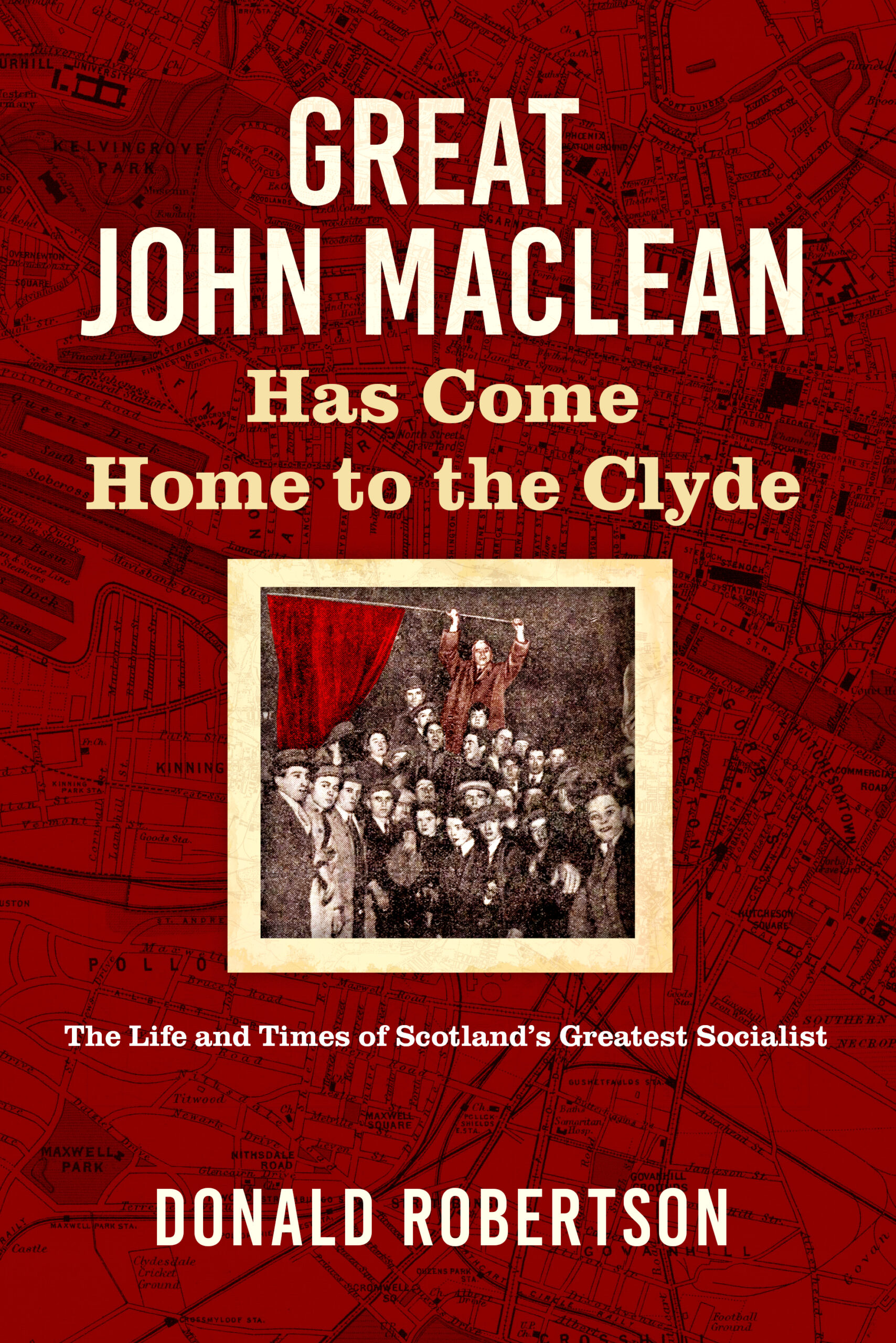
Donald Robertson, Great John Maclean Has Come Home to the Clyde: The Life and Times of Scotland’s Greatest Socialist (Resistance Books: London, 2025). Review by Jim Claven.
This new biography of the Scottish socialist and activist John Maclean is a tour de force.
Well researched and written in a clear and engaging style, its nearly 600 pages include more than 50 pages of references covering a wide range of primary and secondary source material. The author is a Scots-Australian, his steelworker father having brought the family to Australia. The biography is in some ways a personal pilgrimage into an important part of Scottish labour history.
Robertson’s professed aim is to save the story of John Maclean from oblivion. And with this biography, the author has certainly made a major step in that direction. Robertson’s biography is a substantial work devoted to exploring John Maclean’s story and impact. In summary, Robertson provides the reader with a detailed narrative of the key developments in John Maclean’s life and political activism, as well as the social, industrial and political struggles that comprised what has become known as Red Clydeside.
Red Clydeside encompasses the various struggles that broke out across industrial western Scotland and Glasgow in particular during and immediately after WWI. It encompassed rent strikes, the rise of the first major union shop steward’s movement (including the formation of the multi-workplace Clyde Workers Committee), strikes against the dilution of trade skills, support of reduced working hours, for improved working conditions and opposition to the war – all culminating in a massive rally of some 20-25,000 strikers and their supporters in the city’s George Square opposite the City Chambers in January 1919. In response, fears of insurrection saw troops and tanks brought to Glasgow and a major confrontation with police saw many arrested in what became known as Bloody Friday. During the war itself, the rising industrial movement – in the face of what many saw as the industrial conscription provisions of the new Munitions Act; which made strikes illegal – had seen many trade union activists imprisoned. Socialist newspapers were suppressed. One of the important actors in this political ferment was the school teacher and socialist activist John Maclean.
 Robertson explains Maclean’s early life and education, his political awakening and work as a teacher and educationalist. We are told of his well-attended local workers’ socialist educational initiatives, his street meetings and political journalism. These reflected his commitment to introducing local workers to Marxism and raising class consciousness. His increasing clashes with authority are explained, from his dismissal as a classroom teacher to his arrest and imprisonment for contravention of wartime legislation and regulations criminalising opposition to the war. Finally, we see the personal effects of these consequences as his health deteriorated and his estrangement from his family Robertson explains the sometimes confusing evolution of local political and industrial organisations with which Maclean was connected – from the cooperative movement and the Social Democratic Federation to the British Socialist Party and the Scottish Workers Republican Party. He also covers the actions of other key actors in the local struggle, including labour activists Willie Gallagher, David Kirkwood and James Maxton, as well as opponents like Lloyd George, industrialist William Weir and local municipal authorities.
Robertson has also provided the reader with a detailed and well-researched narrative-style biography of one of the key progressive activists to emerge amongst the Scottish labour movement in the years leading up to WWI and through to the immediate post-war years. He reveals Maclean as a dedicated and dogged advocate for working-class industrial and political action.
However, this reviewer would suggest that Maclean’s misreading of the political situation and his experience of imprisonment and political isolation would be reflected in his increasing political sectarianism. Despite his appointment as Bolshevik consul in Glasgow, he bitterly opposed the new Communist Party. It is perhaps not a surprise that his one foray into parliamentary politics for a Glasgow constituency in the 1918 General Election would end in his defeat.
Some historians now consider Red Clydeside and the prospects of revolution on the Clyde to be more of a legend than a reality. They point to the immediate causes of the local struggles and the ultimately non-revolutionary nature of the workers involved. The revolutionary situation may be seen as a chimera created from the fears of conservatives and the hopes of activists like Maclean. The reality was that the social and industrial activism was focused on access to affordable housing, cost-of-living rises, more say over working hours and trade skills retention, as well as for a more responsive trade union leadership. Ultimately; the ferment on the Clyde delivered an important parliamentary outcome in the local Labour landslide at the 1922 election, in which some of Maclean’s labour contemporaries were elected. The debate over their own achievements continues but their support for housing reform leading to an expanded role for public housing provision was a not insignificant legacy of Red Clydeside.
This is not to discount Maclean’s role as a socialist educator and activist. He inspired thousands of ordinary working people to demand his release from prison. His seventy-five-minute speech from the dock in 1918 is legendary in the annals of the Scottish labour movement His untimely death at the age of 44 was met by outpourings of support as thousands followed his funeral procession through Glasgow.
Even those former colleagues now estranged from him came to express their respect for his activism, such as Willie Gallagher and James Maxton. Following his death, Maclean would be eulogised in songs and poems, his memory kept alive by the John Maclean Society and in 1973, a memorial cairn was erected in his honour in Glasgow. Readers interested in the influence of Marxist thought on the trade union movement in the early 20th century will find this new volume of great interest. It paints an important picture of the rise of industrial militancy in a major British city during the First World War and the role played by an individual in stimulating that movement. While it may be considered to have over-emphasised Maclean’s role, this book should be read as a major contribution to the study of a vital stage in Scottish ( and to some degree European) industrial and political history. One unfortunate omission from this otherwise worthwhile read is its lack of an introduction and conclusion, which leaves the reader to discern the central message of the author from his voluminous narrative.
While Maclean is far from being forgotten, Robertson’s achievement is not merely to provide another biography of his subject but to have produced a comprehensive narrative of Maclean and the period for a new generation. This new biography will help ensure that John Maclean’s contribution to the development of working-class political and industrial organisations in Scotland is not forgotten.